Saturday, 28 January 2012

2012 Subaru Impreza WRX - STI

2012 Subaru Impreza WRX - STI PhotosWhile the pedestrian Subaru Impreza sedan and hatchback were thoroughly updated for 2012, the hot-rod Impreza WRX and STI models soldier on with the older and proven body style for another year. Both were restyled last year, with more aggressive styling and substantial suspension and running gear changes, so they're far from outdated.
The 2011 wide-body look includes bulging fenders front and rear, a brawny lower-body look, a macho grille and front-end treatment, and four exhaust tips coming out the back. The new wide-fender styling benefits the four-door sedan most, removing its slab-sided economy-car aspect, whereas the five-door hatchback was always sportier looking. Inside, the trim and upholstery, instrument clusters, and even the audio systems were updated to match.
Both the WRX and STI are offered in either body style. The differences between the two models, though, belie their similar appearances even though they're only apparent once you get behind the wheel.
The 2012 WRX continues with the 265-hp, 2.5-liter horizontally opposed engine, mated to a five-speed manual transmission and Subaru's characteristic all-wheel drive. The STI comes with an even beefier turbocharged flat four, putting out 305 hp, and powering the all-wheel drive through a six-speed manual. Nope, no automatics in the lineup. If you want an automatic, you may not be a suitable WRX or STI buyer. Sorry.
The two engines are only 40 hp apart, but they're tuned quite differently. The WRX is more tractable in all-round usage, with smooth torque coming on fully 1000 rpm lower than its big brother. The slightly larger gaps between each of its five gears makes it feel more flexible, docile even, though in the end less aggressive than the STI.
The STI is jaw-droppingly quick, but can feel flat at low revs until the driver floors it. Once that happens, the engine begins a rising howl and the car rockets forward in a frenzy of acceleration and engine noise. An SI-Drive controller giving the driver the choice of three different tunes--Intelligent (I), Sport (S), or Sport Sharp (S#)--is limited to the STI model. Along with that level of control come stiffer springs, bushings, and stabilizer bars.
A center console switch offers no fewer than six settings to control the lockup behavior of the central differential, and a Super Sport ABS system controls each rear wheel individual to reduce understeer. There's even a "traction" mode in the stability control system, really only meant for track use, that brakes for stability but doesn't cut the throttle at the same time (the system can also be turned off entirely). Larger Brembo performance brakes haul everything down to normal speeds again.
The simpler WRX has fewer of these systems, but is still just as fun to drive--and perhaps easier for mere mortals. With experience, drivers know to blip the throttle while braking, drop a gear, and simply accelerate out of the turn with all four wheels pulling you forward. You can even learn how to make the car induce a little four-wheel slide, very neutral and easily controlled. Both the STI and WRX ride surprisingly well, soaking up ruts, potholes, and other bumps with confidence. And despite their power, the cabin is remarkably quiet inside, though Subaru's traditional weak spot--side mirror noise--is present.
The racing-style bucket seats hold the driver and front passenger firmly in place, but the fixed headrests project forward at an uncomfortable angle.The STI models get fancier black Alcantara trim and upholstery with red stitching, front and rear, though the rear seats remain the standard-issue item from the regular Impreza. Rear-seat space is remarkable for a compact car, with oceans of headroom even for those with tall torsos. From behind the wheel, the instruments are clear--dominated by the central tachometer--and thankfully are for adults, without boy-racer graphics or odd background lighting.
Years ago, the Subaru STI was an economy car with a remarkable engine, all-wheel drive, and handling. Its interior was basic, and it was meant for serious drivers who could put up with some crudeness and a lack of features. Today, WRX buyers would like some of the STI's features, and STI buyers may be eyingBMWs or even Porsches in comparison. So Subaru has added options like leather upholstery and a moonroof, satellite radio, and other quasi-luxury features. Increasingly, these set it apart from its arch-rival, the Mitsubishi Ralliart and Evolution models.

Friday, 27 January 2012

2012 Lexus GX 460

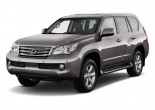
2012 Lexus GX 460 PhotosThe 2012 Lexus GX 460 fits into the Lexus lineup just below the Land Cruiser-based Lexus LX 570. And actually, it is part of the Land Cruiser family; it's a full-featured, extra-luxurious version of the Land Cruiser Prado that sells in other international markets.
The GX is also related to the Toyota 4Runner, and there's a clear differentiation. The Toyota sticks to V-6 engines and simpler features and appointments, while the GX gets a strong V-8 engine, power-folding third-row seats, and a host of luxury and technology options—plus Lexus levels of refinement.
This is the third year for the GX in its current iteration, and with the last redesign designers didn't push the envelope much. The only real changes to the GX 460 for 2012 include the addition of color-keyed bodyside molding, and a new high-gloss wheel finish for the Premium model. In all, you won't find the GX 460 to be extroverted or flashy, rather organic, and a gently rounded take on the classic SUV proportions—although carrying a 'machined' look from Toyota's larger truck designs that separates it from other Lexus cars and crossovers. Alongside, the GX looks the most 'trucky,' because of its carved-out fenders and very tall, imposing beltline, while inside, the look and layout are upright but definitely up to Lexus standards.
With its low running boards, chrome trim all around, and what could be seen as a delicate interior, you might not expect the GX 460 to be a serious rock-crawler. In that, you'd be right; but it's definitely more than another off-road poseur. The full-time four-wheel drive system includes a Torsen center differential and distributes power 60 percent to the rear wheels in normal driving, with more sent to the rear wheels during acceleration. There's also a low range for this tough body-on-frame ute, a host of electronic controls that will help you maintain control in various conditions, and a true center diff lock that you'd use for sand, mud, or snow.
On the road, the 2012 Lexus GX 460 accelerates strongly, with its big, torquey 301-horsepower V-8—0 to 60 mph in 7.8 seconds—and the six-speed automatic transmission provides quick, smooth shifts. And even though the suspension helps keep it level in corners, light, long-ratio steering and a soft brake pedal enforce the idea that it's a traditional SUV at heart. Fuel economy is, as you might guess, embarrassingly low for a daily driver, at an EPA 15/20 mpg.
In fact, anyone who's driven a truck-based SUV in the past will be right at home in the GX 460. You sit high relative to the beltline, at least compared to other new vehicles, so there's great outward visibility. Seating in the GX 460 is superb in front, with nicely padded seats affording plenty of support plus good headroom and legroom and a general feeling of spaciousness. The second row is very roomy, too. As for the third row, it makes little sense; it's very small, and the power-folding mechanism that's mandatory occupies some of the space behind, keeping the cargo floor from being flat and low. What's more, the side-opening hatch opens on the wrong side for easy curb loading.
On the plus side, the GX 460 is supremely refined, with nearly no road and wind noise, although you do hear the engine whenever accelerating, more than some might expect. Ride quality is quite good, whether or not you get the Adaptive Variable Suspension that comes with Premium-grade models, but there's a bit more 'head-toss' on choppy roads.
You simply won't have to worry about whether the 2012 Lexus GX 460 comes well-equipped; it comes with all the common convenience and luxury features, while the Premium grade steps up to the rich infotainment features and tech extras. Highlights include a safety-tech package, 330-watt Mark Levinson surround sound, a rear seat entertainment system, and Intuitive Park Assist.

Thursday, 26 January 2012

2012 Lexus RX 350

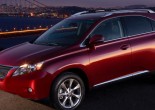
2012 Lexus RX 350 PhotosThe 2012 Lexus RX 350 plays it safe and comfortable in the luxury crossover segments. It's been a longtime favorite because of its smooth performance and pleasant looks, not to mention Lexus' reputation for dealer service and reliability. It's essentially unchanged for the new model year, as is the case with its hybrid companion, the Lexus RX 450h.


The RX's shape is familiar for a reason--it's a careful evolution of the look that spawned the luxury-crossover class back in the 1990s. Redone in 2010, the RX still aims for pleasant rather than inspired. It has a more blunt nose now, and its shoulders sit higher, but the same smooth design essence is still present inside and out. The luxurious tall wagon adopted Lexus' latest interior design two years ago, too, and it's built around a single sweeping line that divides the dash into driver and passenger zones. Aside from that, there's isn't much visual drama, and when compared to the Lexuses of the past, the RX's interior materials seem just the slightest bit less rich than before.

Comfort comes before performance in the RX 350. It's relatively responsive and refined, but not at all exciting or nimble. Power comes from a 275-horsepower, 3.5-liter V-6 coupled to a six-speed automatic transmission; front-wheel drive is standard, with all-wheel drive an option. Even with the heavier AWD system, the RX 350 steps off the line quickly and smoothly, with buttery transmission shifts. The RX doesn't offer serious drivers much feedback in the steering or brakes, though it's better than its hybrid counterpart in that respect--it specializes in muting the outside world as much through its controls as through its luxury accoutrements.

The RX's cozy interior leaves no doubts as to why it's such a popular luxury wagon. It's easy to step in and out of the RX, given its ideal height, and four adults will be very comfortable, with good knee room in back and in front. The tallest passengers might find it a bit tight on headroom. The high standards for seating set by other Lexus ,vehicles is met with available leather upholstery that's less highly treated than in the past, giving it a more individual look and feel. An upgraded wood trim package is almost opulent.

Plush and well stocked, the RX 350 has standard power front seats; power windows, locks and mirrors; AM/FM/XM/CD player; Bluetooth; and dual-zone climate control. Major options include leather; a USB port; navigation with real-time traffic; a rear-seat DVD entertainment system; and a superb Mark Levinson sound system. Lexus has adopted a "Remote Touch" controller bundled with its navigation system; it acts like a computer mouse to control audio, climate, GPS and other systems. It's yet another distinct take on infotainment interfaces, albeit one that takes less time to learn than the knob-style systems from Germany, or the voice-command-driven MyFord Touch system.

Tuesday, 24 January 2012

Kia Recalls Over 145,000 Optimas, Rondos For Airbag Flaw

2007 Kia Optima LXKia Motors Corporation has issued a recall for the2006 - 2008 Optima sedan and for the 2007 -2008 Kia Rondo. In those vehicles, Kia has identified a problem with the driver's side airbag that could prevent the airbag from deploying during an accident.


The flaw is linked to Optimas manufactured between September 29, 2005 and January 29, 2008, and to Rondos build from September 13, 2006 to March 21, 2008. All told, some 145,755vehicles are included in the recall.

If this sounds a little familiar, it should: last September, Kia's sister company, Hyundai, issued an identical recall for the 2007 - 2008 Santa Fe and Veracruz. Then as now, the flaw lies with the clock spring contact assembly that helps fire the driver's side airbag. According to both recall notices, over time that assembly can force a buildup of resistance in a vehicle's electrical circuits, which could stop the driver's side airbag from deploying during a collision. Not good.

Also not good: according to a bulletin from the National Highway Traffic Safety Administration, the Kia recall is paced much slower than Hyundai's. Kia owners shouldn't expect to receive notice of the recall until March of this year. At that time, owners will be able to take their vehicles to a Kia dealer, who will inspect the clock spring assembly and replace it "as necessary". (That's the NHTSA's phrase, not ours.)
If you have questions in the meantime, we encourage you to contact your local dealer, or call Kia Customer Assistance at 800-333-4542 and ask about recall SC094. You can also contact the NHTSA at 888-327-4236 and inquire about recall campaign #12V014000.

Monday, 23 January 2012

2012 Kia Optima

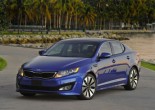
2012 Kia Optima PhotosWhen it was redesigned in 2011, the Kia Optima pitched its bland, unremarkable past and went for broke. The gamble paid off handsomely, and today's Optima isn't just one of the best family sedans for economy, it's also one of the best-looking cars of its kind--and some other kinds, too.


It's squarely in the same class with the likes of the Honda Accord, Toyota Camry and a host of other family four-doors, but there's very little square in the Optima's arresting profile. Kia's distinct styling direction is a polar opposite of the exuberant, sculptural look that's all over the Hyundai lineup and the Optima's fraternal twin, the Sonata sedan. The Optima contrasts with a sporty, European-tinged look with a lower roofline, stretched headlamps, and a nifty upkick in its rear quarters. It's exciting--focused, clean, laid-back, with an athletic stance and flashy chrome wheels. The interior's a fine match, with a big set of gauges and a wide rectangular bank of controls canted toward the driver, ersatz Audi with almost all of the sophistication and less clutter.

In performance, the Optima caters to three types of drivers. Base cars have a 2.4-liter four-cylinder with direct injection, 200 horsepower and just a touch of unremarkable noise and vibration when it's wound out. A manual six-speed is offered; we've tested the six-speed automatic, which teams expertly with the four. A turbocharged SX variant whistles along with 274 horsepower and paddle controls for the automatic, upconverting the Optima's personality into something authentically sporty, along the lines of the latest Buick Regal or the VW CC.

On top of the complexity curve is the Hybrid, which teams up the basic four-cylinder with electric motors and batteries that, in our opinion, could use more work on smoothing and integrating the juddering that sometimes comes at midrange speeds, when the hybrid drivetrain drops gas power to operate on electric charge alone. With all powertrains, highway gas mileage hits a minimum of 33 mpg in turbos, with four-cylinders hitting a stellar 35 mpg and hybrids reaching to a rated 40 mpg. We've had difficulty hitting the hybrid's high-water marks, but the basic Optima offers repeatable, real-world gas mileage that's tops in its class, and equal to some economy cars.
Ride and handling fit into the upper echelon of the segment. The engines work well in concert with the independent suspension, giving the Optima a quick, nimble feel. The Optima's steering is a little hefty and responds quickly, doing a better job than the similar Sonata at controlling a little bit of wandering that comes with some kinds of road surfaces and its fuel-economy-aiding tires. All the while, ride quality is firm but comfortable, and the Optima's cabin is a quiet, refined place to be.

Space is a virtue in the Optima, save for a little less head room than we've found in the Sonata and by a wide margin in the cathedral-like 2012 VW Passat. The Optima's front seats have flat, short bottom cushions, which cuts into the kind of long-distance comfort that the Accord delivers mile after mile. Leg room is a long suit, especially up front, and the Optima's back seat accommodates all but the tallest passengers with ease. Heated and cooled front seats are an option, and the back seats can be heated, too.

The Georgia-built Optima has an excellent safety record. The NHTSA awards it five stars in all categories in which it tests, and the IIHS calls it a Top Safety Pick. Aside from the usual airbags and stability control, the Optima also has standard Bluetooth and an available rearview camera, which mitigates the visibility issues its rear-end styling creates.

Features remain a strength throughout the Kia lineup, and the Optima is no exception. It's a lot of value for the money, with standard power features, cruise control, a USB port and satellite radio. Even mid-level EX trims get things like dual-zone climate control and a smart-key system, with options for leather trim, a panoramic sunroof and Infinity audio. A navigation system is available, as is UVO, Kia's flavor of the Microsoft-written software also sold as Ford's SYNC. The Kia version has fewer voice commands in its vocabulary--and it's also deleted when the navigation system is ordered.